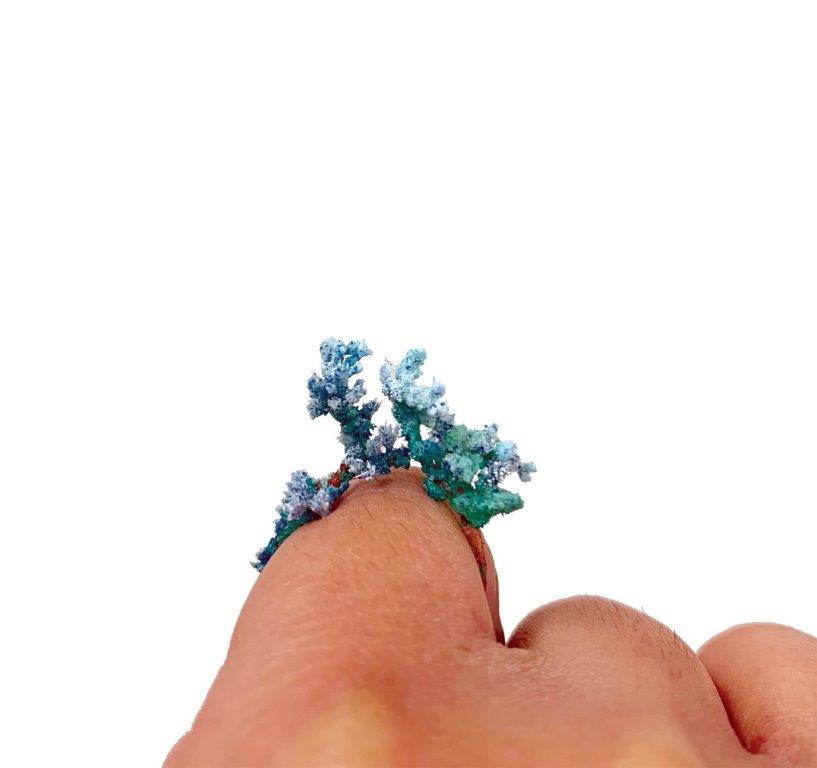
19 December 2019
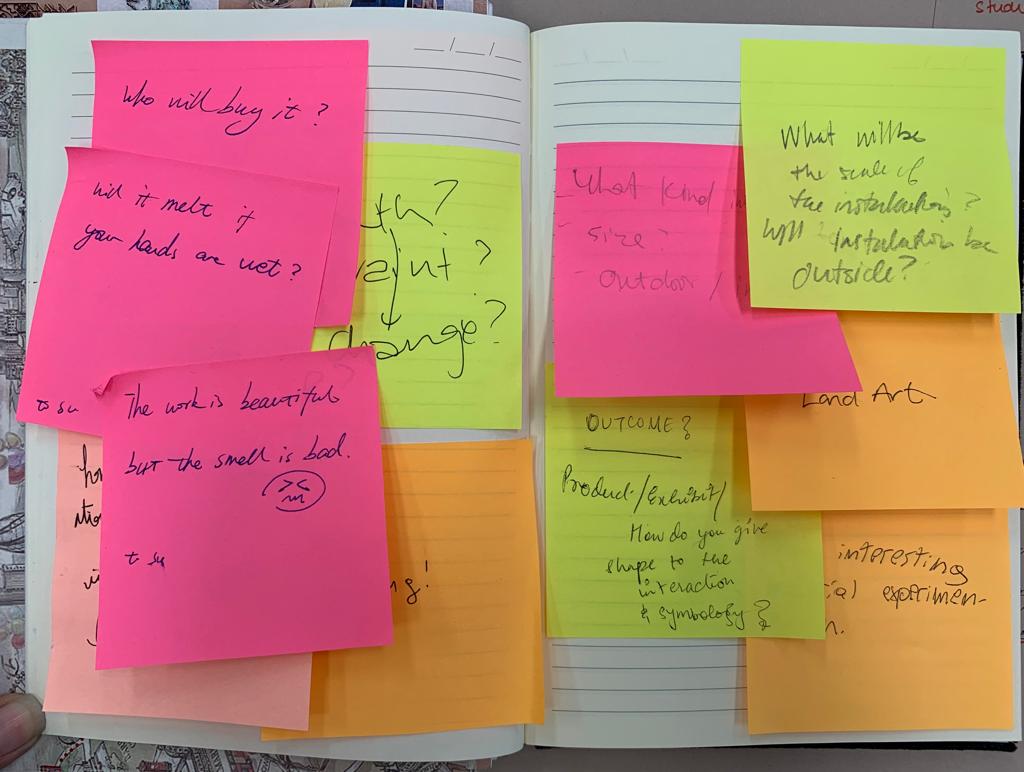
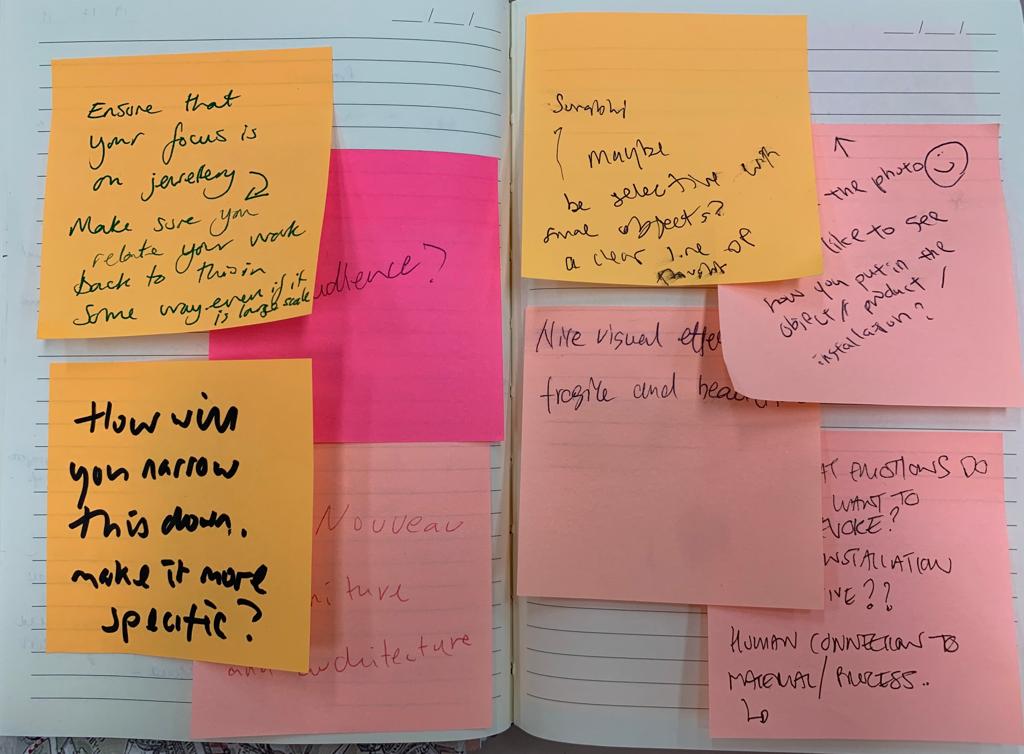
Thanks everyone who wrote feedback for my elevator pitch!
SUBJECT AREAS:
Context / historical / political / geographic / site
1. Growth? Constraint? Change? Use?
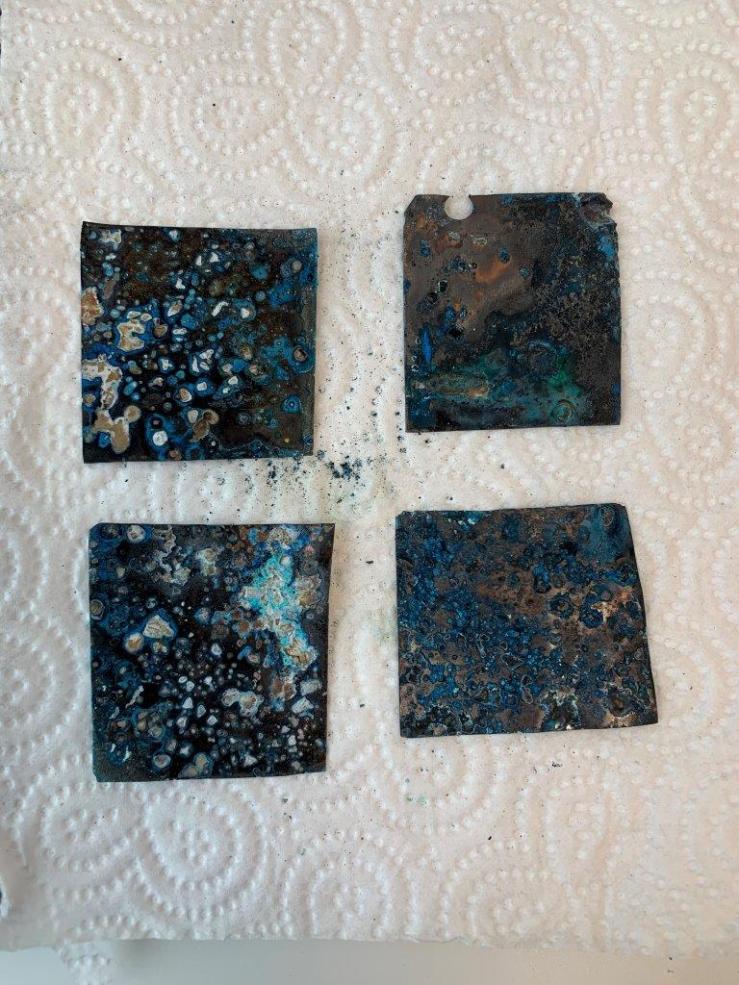
The first comment seems to question my intention to apply narratives of growth and transience into my final work, as mentioned in my elevator pitch. I enjoyed working with the contrasting effects that materials posed, during the processes of (corrosive) patina formation, and (fertile) crystallization of salts. Taking this material contrast in the metaphorical sense, I would like to question/ comment/ present such a contrasting narrative between simultaneous cycles of growth and decay in nature and the human environment. Moreover, questioning the ‘synthetic’ nature of growth and decay (created and manipulated by me) I’d also like to question what is real, natural, artificial, human, human made, in today’s world. This is something I started thinking about while studying Olafur Eliasson’s works for my ADAS essay, and is something I am curious about discussing with my audience. Thus, I would like to deal with this question as a contextual reference, and study works expressing such questions and narratives through the critical application of materials and processes. Learning from precedents would help to eventually apply such a symbolic narrative to an emotional or utilitarian object in the everyday context, prompting thought and engagement (similar to the subtle provocation I felt on encountering Olafur’s works).
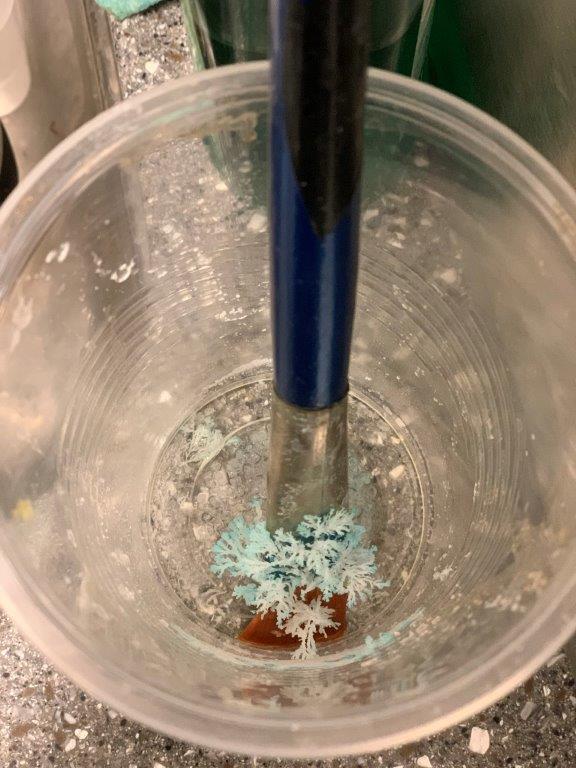
2. Nice visual effect! Fragile and beautiful
The compliment conveys to me that the fragile, dendritic and organic forms, along with the colours and textures represented in my processes and outcomes from the Investigate project, appeal to the aesthetic sensibilities of my audience (here, my peers and tutors). The contextual application of such a discovery could be to either question the concepts of aesthetics and visual taste (maybe challenge the concepts of beauty by presenting something contrasting in visual effect?), or to use this aesthetic appeal, in translating my message/ question across to my audience, first engaging with them through their initial attraction to something they perceive as ‘attractive’, and then appealing to their emotions in questioning the provenance of such innate attraction… (I’d prefer to try the latter)
3. Land Art?
The reference to Land Art makes me want to connect my experiment with the larger, spatial scale of the environment around. Since the physical scale of my salt crystals is limited to the human scale, I might consider metaphoric or symbolic engagement with nature and the environment through the medium of the human body and its movement (from ‘indoors’ to ‘outdoors’).
This brings me to the potential site for my installation- Can I place my installation on the human body? (I want to hold back from calling it jewellery, since I find it difficult to connect with the concept of ‘adornment’ that is so commonly associated with jewellery, but I’d like to challenge that, by challenging the conventional connotations of jewellery. But first, some research on what jewellery really means to people: the provenance of jewellery as designed/crafted objects) Keeping my material and process exploration close to the human body, I could potentially connect my narratives with not only the human emotion and sensibility, but also to the spatial scale of nature and the environment. Sitting on the body, my installation could follow the body in its movement from inside to outside..
Ethical considerations / sustainability
4. The work is beautiful but the smell is bad :<
I understand that the smell of vinegar could be overpowering in the studio, and will try to carry out further experiments away from shared spaces. The lack of open space availability, both at my accommodation and at school makes me consider the 3D making space as the only other alternative.. Or I could work in the corridor outside the school building during working hours and shift my work inside after hours.. Smaller scale works could be easily carried out in my apartment as well.
Coming to the perception of the smell of vinegar as bad, from my audience’s perspective – could the bad smell in the final work be a purposeful attempt within the narrative generation? In my intention to replenish the growth medium through an interactive, dynamic installation, should I reconsider the use of vinegar in public areas? This would also depend on some research into the effect of evaporation of vinegar on the air composition in closed and open spaces.
Sustainability – The utilization of common salt and vinegar in creating visual effects had me convinced that my approach had been ‘non-toxic’ and sustainable, however, I feel that I need more research into the effect of the molten patinas and crystals on the human skin, environment and air quality to consider putting the installation in the context of the body and environment. I have been mindful of reusing chemicals such as copper sulphate and ammonia so as not to cause chemical pollution, but would like to find out the right disposal methods for these chemicals so as to conduct my experiments ethically.
Audience / users / stakeholders / markets / sector
5. Audience?
The question of identifying my audience makes a lot of sense at this stage, since it is imperative to the ’emotional connect’ I hope to create through my work. This is also deeply related to the questions of final outcome as mentioned in the next subject area – depending on the scale, context, purpose and user experience of the final product, I’d like to situate it within the context of the right kind of audience to engage with..
5. Who will buy it?
Until now, I hadn’t thought of the idea of ‘selling’ this work, I had imagined it to be a one-off installation without a specific context in mind. However, this question makes me think about the potential commercial aspects to consider in relating the materials and processes to a potential audience.. In addition to who will buy it, I also want to think about ‘why they would buy it?’ and ‘what they could do with it?’ I am reminded of a discussion with Isabel on how conceptual design works in terms of the market sector – with conceptual designers (we discussed Gijs Bakker) making more relatable, commercial pieces for a mass audience and some deeply conceptual, potentially unusable pieces for galleries or a niche clientele, thus effectively covering different kinds of markets, and also allowing them to convey their concepts efficiently to varying audiences. In either respect, i’d like to start by trying to connect this material experimentation with people, physically or by engaging in discussions about the idea, in order to gauge their responses, interest and suggestions.
Purpose / function / use / user experience/ application
6. Surabhi maybe be selective with final objects? a clear line of thought
7. How will you narrow this down, make it more specific?
I agree on the need to narrow down my potential ideas and be specific about the final products that i will be engaging with in my Realize project. I may be excited to have been exposed to new and inspiring processes and materials in this experiment, and would no doubt like to explore them further. However, for the scope of my current project, i’d surely need to narrow down on an approach or an outcome, so that I don’t get lost in the vast and inspiring world of crystallization, metalsmithing, electroforming and patinas. These could be further research for future projects and undertakings as and when..
8. OUTCOME? Product/Exhibit –
9. Ensure that your focus is on Jewellery – make sure you relate your work back to this in some way even if it is large scale
Could my final work be both, a product, and an exhibit? Can jewellery be an installation? Can an installation be a product?
10. What kind of installation? Size? Outdoor/Indoor?
11. What will be the scale of the installation? Will it be outside?
An installation that can sit on the human body, move along with the movement of the body, respond to natural and human made conditions as a fragile, organic being, yet contrast its non-living, immortal characteristics with those of the wearer?
Size and site – responsive to the scale of the human body – conventional sites like the fingers, wrists, neck, ears? or new locations on the body with potential to convey my narratives more effectively?
11. What emotions do you want to evoke? Is the installation interactive?? Human connection to material/process?
I am still working on the kind of emotions and narrative I wish to convey.. I have been thinking about the nature of relationships we have with our surroundings, with nature and our human made environment. I don’t really have a specific message to convey to my audience, but would definitely like to express my curiosity towards natural processes of growth and decay, which, in my work are a synthetic recreation instead. Maybe I wish to present these contrasts and let people make of them what they wish..
By interactive, I would like the work to engage with my audience, either physically, or emotionally/intellectually, or both. Within the physical interaction, lies the fragile nature of the salt crystals, their potential to break away, shed off or be dissolved when subjected to the slightest intervention. However, the re-growth of crystals, under the right ‘conditions’ (read growth medium, temperature and patient waiting) would allow a layer of intellectual stimulation in appealing to the minds of the users.
I guess the human connect in this case would come physically from sitting on their body, tagging along in their every movement and activity, remaining in tactile contact, possibly visual and olfactory sensations.. However, the emotional connect might come when the installation is removed from the body – to undergo a replenishment, or regrowth away from the intervention of the human.
12. Very Interesting material experimentation
Thank you! Now to make the materials and processes relatable to my audience..
13. Will it melt if your hands are wet?
Yes. Salt crystals would be dissolved in water, unless I coat them with a protective layer of clear varnish/fixatiff. Honestly, I’m not sure If I’d like to consider that, depending on where I’d like these objects to end up. If I hope to create a niche product, telling a story, It would be worth a while to keep the fragile nature of the salt crystals as the center point of my story, provided the molten salts from the reaction between copper and vinegar are safe for human contact. As a commercial product, the crystals would have to be coated with anti-corrosive coatings to ensure safety and lasting use.
Precedent / research / gallery & museum visits / site visits (Further Research)
14. Land Art
Land art or earth art is art that is made directly in the landscape, sculpting the land itself into earthworks or making structures in the landscape using natural materials such as rocks or twigs
https://www.tate.org.uk/art/art-terms/l/land-art
I’d like to explore examples of Land Art, and see if I can relate this to the Bio-inspired aesthetic i’m currently exploring in my realize project. I can see a contrast within the workings of Bio-engineering and Land-art in the sense that Bio-engineering utilizes the manipulation of natural processes in generation of ‘organic’ forms, while land art explores land as a site for artistic expression with ‘natural’ materials, yet an aesthetic developed purely out of human aesthetic taste..
15. Art Nouveau in Furniture and Architecture
Kyung Hwa’s suggestion to study Art Nouveau was probably out of my exploration of organic forms in the salt experiment. I understand that Art Nouveau was a decorative style, utilizing exaggerated curves within organic and floral shapes.. I’m not sure that i’m looking at creating a decorative aesthetic in particular, however, I’m very interested in the aesthetic created by growth in organic processes. I also feel that aligning with a style limits aesthetic expression, especially since I don’t particularly relate with the aesthetics of this style. However, I am interested in exploring Postmodernism in its vast scope to accommodate the application of concepts and narratives using a variety of materials and resulting in eclectic and non-conformist aesthetics.
A precedent I identified while toying with the idea of nature-inspired jewellery, was Lorenzo Pepe’s drOphius collection of rings and pendants. Using Ceramics and various oxidation processes, Lorenzo brings out the aesthetics of natural harmony in his unique pieces of jewellery. I also feel that he manages to connect his fascination for natural growth structures with his audience successfully, something I would like to work upon in this project.
Methodology / process / materials (Execution)
16. Love the photo 🙂 Would like to see how you put in the object/product/installation?
17. How will this experiment be translated into an interactive installation?
Having conducted a further set of experiments, I have identified areas of potential application of the experiments from the investigate project. I applied a combination of colours from corrosion of copper and crystals from salt absorption and evaporative deposition to this acrylic butterfly, resulting in a natural gradation of colours and shades, not previously exhibited iin singular approaches towards each of these processes. Constrained by the scale of the crystals to actually be appreciable, I am keen on creating objects as installations for the body, in the translation of narratives relating to growth, decay, natural and artificial, synthesis and transience. In order to do this, I would like to create test pieces of this scale, reversing my previous approach of feeding non-absorbent materials with wood strips or sawdust in order to cause absorption of salt and vinegar solution.
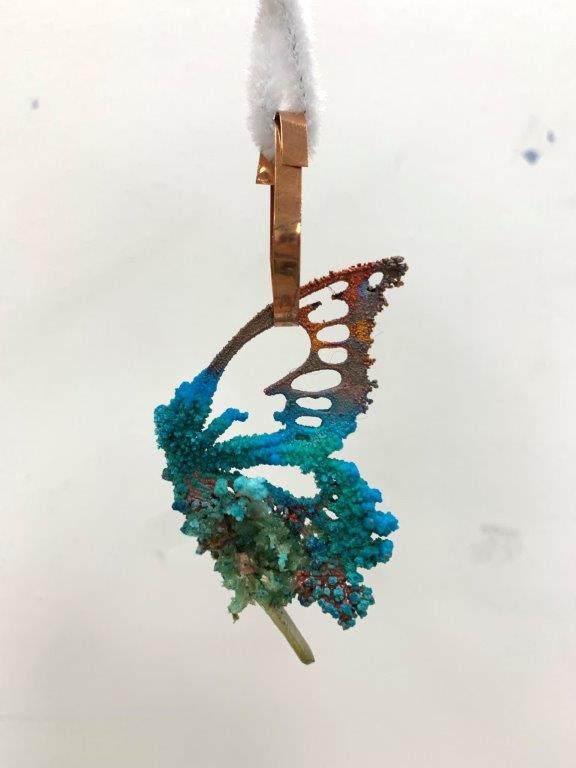
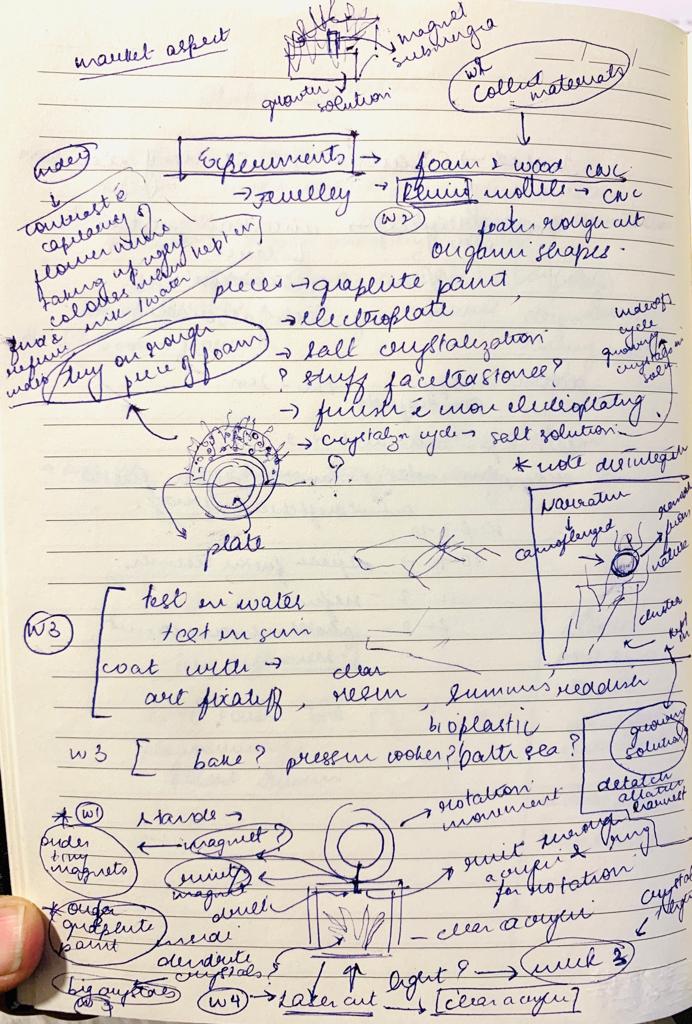
Using absorbents as the base material, I hope to subject parts of these materials to prolonged electroforming, resultinig in organic deposition of copper crystals. Further, subjecting the exposed edges of absorbents to salt crystallization, I would like to ‘grow’ salt crystals and invite colour gradients as in the case of the acrylic butterfly above.
18. How do you give shape to the interaction and symbology?
19. Amazing!
Thanks Wooli!
Reconsidering my SOI from a new perspective:
I feel that my feedback suggests looking at the Functional and Audience/user experience aspects a bit deeper, since I haven’t been working on these as much as my material and process experimentation. Moreover, Identifying an audience, a market and a functional context would definitely help in translating my thoughts to my audience through my materials and processes. Keeping this in mind, I’d like to incorporate in my Research topics, the safety considerations of using salts and patinas in contact with the skin, and the effects of a continued narrative experiment on air quality. Moreover, In order to situate my objects on the body, I’d like to study the provenance of jewellery and its relationship to the human body, emotional jewellery and the use of jewellery in emotional stimulation. Having narrowed my approach for this project to electroforming and salt crystallization, I’d like to continue my intended research on natural gemstone formation, synthetic stones and bio-engineering as further research, relating to further potential projects after P05.
Conducting tests on smaller scaled absorbent materials, I hope to proceed toward converting my experimentation into a resolved body of work. In parallel, I’d like to explore precedents like Lygia Clark and Olafur Eliasson, who manage to translate narratives into objects and artwork, through their unique application of materials.
Considering my work from the market sector perspective, Id like to approach this as an emotional product, appealing to the aesthetic sensibilities of my audience. For this, I’d like to study the jewellery designs of Gijs Bakker, Carlier Makigawa, Ted noten and David Roux Foullet, amongst many others.
Updated Time Plan for the Realize Project
| WEEK | ACTIVITY | METHODS/ MATERIALS/ PROCESSES | RESEARCH | NOTES |
| Week 1 Research /develop | -Make experiments relatable and functional – final outcome -Explore natural and synthetic crystal formation – Visit to natural history Museum Explore light, space, body connect with material experimentation – acrylic butterfly, copper ring, light through electroplated salt mesh | Combination of salt crystallization and prolonged electroplating, along with patina formation allowing colour gradients | -Theoretical research – potential application of crystallization methods for different salts, resulting shapes and properties -Application of concepts and testing | -Explore flame fusion, solution crystallization for Beryls and Quartz respectively – narratives of synthetic and natural -Scale – aesthetics and form – most responsive to human scale |
| Christmas Break Research /develop | -Further Reading – crystal formation in nature, synthetic crystallography -Scale up salt absorption, light bulb experiment, outdoor absorption experiment, crystallization on organic matter – twigs | – same materials – push scale and application -introduce found organics and inorganic materials | -Emotional Design book – appeal to human emotions -Reading – complexities of human nature -Research methods for product design -Unexpected pleasures – revisit | -Talking to people about my ideas – helped me push my thinking toward making my final outcome more relatable – inspire curiosity amongst my audience – continue this discussion |
| Week 2 Experiment | -Test electroplated absorbents for colours and gradient -create rhino model for cnc milling of shaped absorbents -Test found metal objects for colours and gradient -Flame fusion for synthetic gems (battersea) ADAS – Identify and refine Question/ thread MA application – seek portfolio advice | – Absorbents like balsa, hardwood, pine, high density foam – as base for electroplating, crystallization and further patination | -How to make it safe and ergonomic for human contact -How to translate narrative through material? (emotional design reading) -previously identified precedents – tyler thrasher, Odd Matter, Stanley Lechtzin | Buy graphite paint for electroplating, magnets for display and growth medium experiment Jewellery – study background, what it means to people, their expectations, challenge assumptions and convention Ask Anna for advice on flame fusion – OH flame – done – cannot be accessed |
| Week 3 Refine | -Explore application of narratives through growth medium documentation experiment -Explore commercial aspects of selling/presenting outcomes as emotional jewellery -consider functional and practical aspects for final outcome | -Design laser cut acrylic formwork for growth medium display | -Precedents – questioning the concept of adornment, meaning of jewellery | -collect, buy appropriate absorbents for cnc – Book CNC, carry out Cry. and Ele. on absorbents |
| Week 4 Produce | -refine rhino designs for ergonomics refine shapes and manipulate colours -create presentation props and final objects after experimentation | -Rhino (if successful) -Materials from experimentation – foam, wood, others? | -Adas Research and essay refinement – V&A – In the Palm of your hand workshop | -book laser cutter -Buy acrylic -replenish Copper sulfate if needed |
| Week 5 Finish | -Finishing of commercial objects – skin friendly and long lasting -presentation of conceptual objects – narrative and emotional stimulus | -Polish and coat – wax? Varnish? clear Bioplastic? -Organic skin friendly materials for coating | Book Camera and Capture Studio |

 design factory