
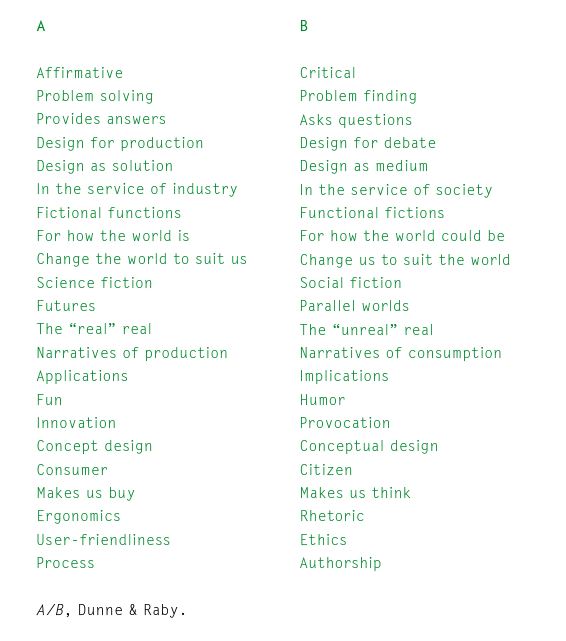
Reading Notes
- This potential to use the language of design to pose questions, provoke and inspire is conceptual design’s defining feature. (beyod the limits of reality)
- They (conceptual designs) celebrate their unreality and take full advantage of being made from ideas.
- Rather than waiting for commissions from industry or seeking out market gaps for new products, designers could work with curators and other professionals, independently of industry, in partnership with organizations focused on society in the broadest sense, not just business.
- Once we accept that conceptual design is more than a style option, corporate propaganda, or designer self promotion, what uses can it take on? There are many possibilities – socially engaged design for raising awareness; satire and critique; inspiration, reflection, highbrow entertainment; aesthetic explorations; speculation about possible futures; and as a catalyst for change.
- Critical thinking – not taking things for granted, being skeptical, always questioning what is given. (not to be confused with commentary – already known and understood questions)
- to confront us with alternative needs and hint at a parallel world of everyday philosophical products
- The most threatening act of protest for a capitalist system would be for its citizens to refuse to consume.
- One of critical design’s roles is to question the limited range of emotional and psychological experiences offered through designed products. Design is assumed only to make things nice, it is as if all designers have taken an unspoken Hippocratic oath to never make anything ugly or think a negative thought. This limits and prevents designers from fully engaging with and designing for the complexities of human nature, which of course, is not always nice.
- For critical design to be successful, viewers need to make up their mind. It would be very easy to preach: a skillful use of satire and irony can engage the audience in a more constructive way by appealing to the imagination as well as engaging the intellect.
- Critical design needs to be closer to the everyday – that’s where its power to disturb lies.
- coexistence in the here-and-now and yet-to-exist..
- Envisioning Real Utopias – Erik Olin Wright
- Use speculative designs to debate political, cultural, social, ethical implications of scientific research/technological progress
- Synthetic Biology, industrial biotechnology (Look up)

 design factory