
08 December 2019
BISMUTH:
At the RCA Fete, I was intriguied by Sara Chyan‘s holographic Bismuth jewellery, which was based on the concepts of melting and crystallization, and further oxidation of bismuth metal, the processes giving it geometric shapes and holographic colours respectively. This video helped me visualize the process in detail. I think that exploiting the low melting point of bismuth, combined with its interesting crystal shapes was an innovative idea, but also think it could be pushed further in terms of applications, considering it is hardy (as compared to my salt crystals) and has a unique aesthetic. However, with the price of bismuth ingots ranging between 25-30 pounds a kilo, I would have to work out wastage during the process to decide on larger sized objects.
Some of Sara’s other jewellery uses Gallium (melting point 29.76 C), causing gradual transformations in its silvery shape and composition when placed within a hollow, clear (acrylic?) bangle. I found this transformation quite interesting, and would like to think about the fragility and transience of my common salt crystals with this transformative approach.
COPPER SULPHATE
‘Seizure‘, by Roger Hiorns, was an immersive installation created by flooding 75,000 litres of liquid copper sulphate solution in an abandoned, soon to be demolished council flat in Southwark. The subsequent removal of excess fluid from the waterproofed interior of the flat, after a month-long period of crystallization, resulted in a blue crystal cave – reflecting light from cracks and some scattered lightbulbs. The installation represented the transient nature of the flat in its materiality, with each visitor ‘contaminating’ and ‘destroying’ some part of the work by trampling and introducing impurities in the space. Moreover, the installation was to be protected from humidity and heat, to prevent the crystals from degrading, which interestingly reveals the transient nature of the work. It was eventually relocated to Yorkshire Sculpture Park for public view, since the council building was to be demolished, upon reaching its structural lifespan.
(POTASH ALUM?) CRYSTAL GROWTHS ON CERAMICS
I was keen on visiting Chance Encounters at the FUMI Gallery to look at Lukas Wegwerth‘s crystal accented ceramics works, made by applying crystal growing chemical solution on unglazed portions of his vases. On viewing the pieces, I realized they were much smaller than the size I had anticipated, but were interesting nevertheless. I felt like I was missing a narrative when viewing these pieces together on one of the shelves in the gallery, and wished there was more of the artist’s story incorporated within the display, but I guess that was a curation thing..
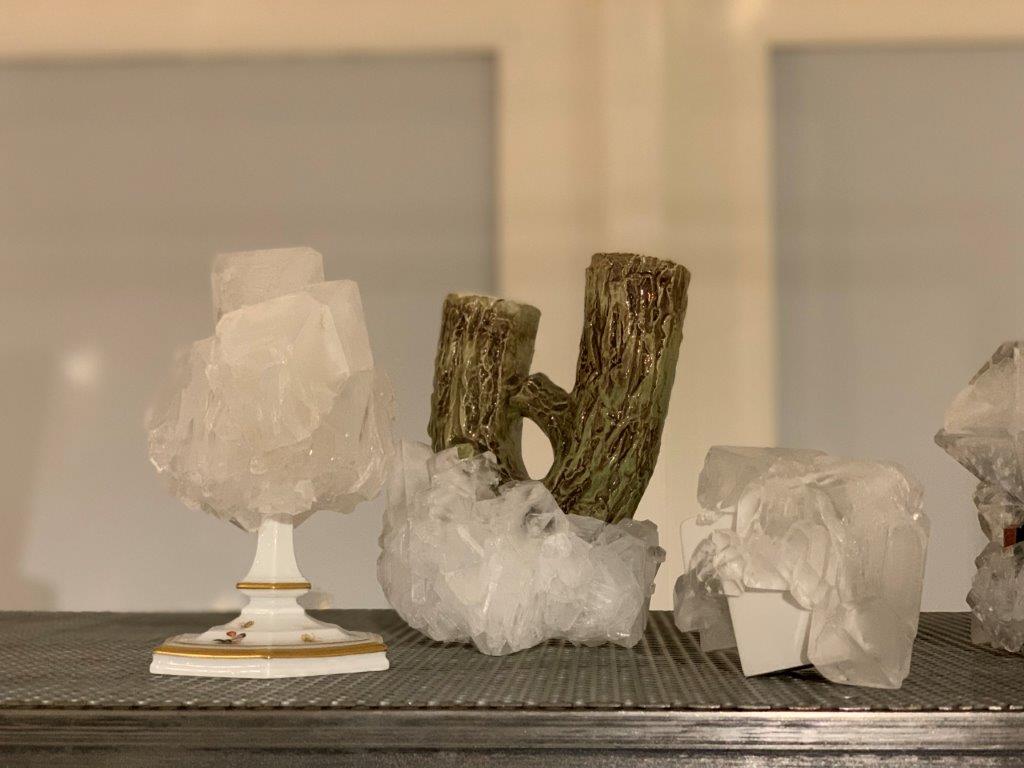
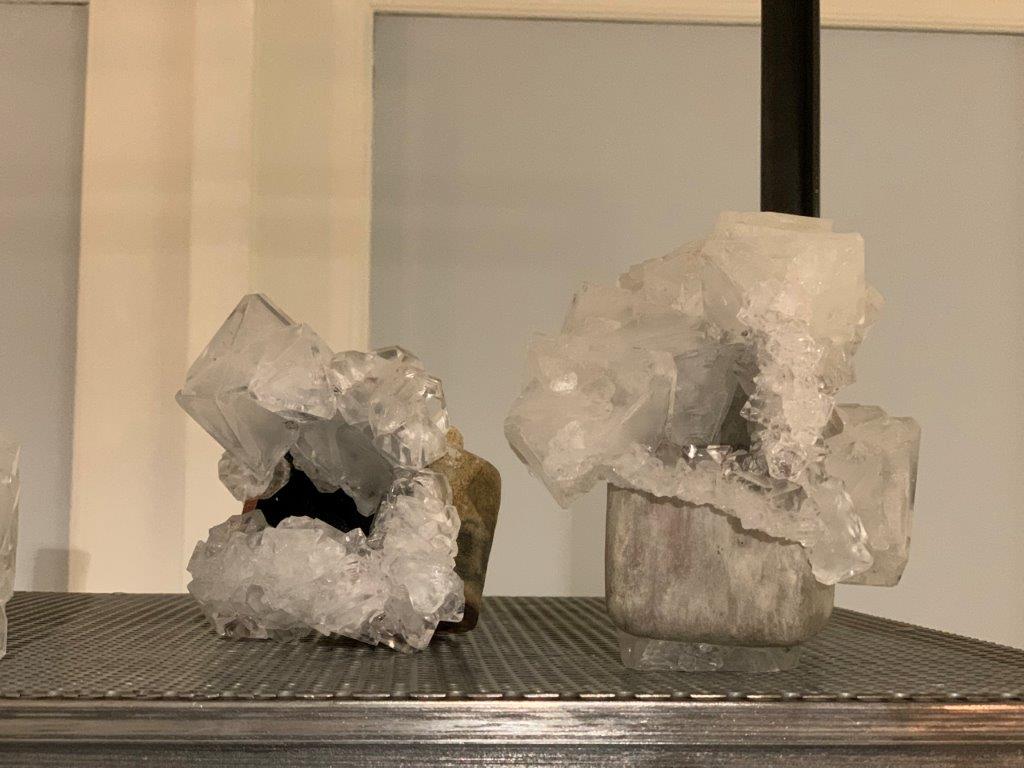
Lukas Wegwerth discovered crystallization when he went out looking for a solution to repair a broken teapot, and was also inspired by the Japanese repair method of “kintsugi’ which highlights broken edges of ceramic works using gold dust. Lukas applies a special salt solution inviting the organic growth of salt crystals that act like a glue that gives a second life to his broken pieces. Although the exact process has not been revealed on his website, I am assuming that he uses Potassium Alum as his crystal medium, from the visual properties of potash alum crystals observed in this video; with the broken edges of ceramics providing the right friction and porosity for seed crystals to settle and grow. Moreover, the crystals seem to have been formed out of submergence and accumulation, with the artist removing the ceramics objects from the crystal solution when satisfied of their size and growth.
The artworks are an inspiring application of the crystallization process, especially the exploitation of the glassy appearance of potash alum (still looking to confirm this). However, what might have been a chance experiment, seems to now have taken the course of a commercialized art product, which somehow loses its narrative value for me. (I’m wondering now, if each piece is built ro be broken, only to be ‘glued’ back together with crystal solution?) My studies on Lukas’ works have yet to reveal the exploitation of the transformative nature of his works over time, as described here. Note: I might be cynical of this kind of practice partly because I have been deeply influenced by Olafur Eliasson’s empowering works at the TATE, where the concepts and mechanisms behind each work are explicitly exposed, as opposed to being hidden for the sake of trickery, shock value or confidentiality of the creative process.
REFLECTION
In most of the above, artists have tried to exploit the natural properties and reactions of materials by setting up ‘an environment’ for chemical and bioengineering processes to take place, with very little or no control over the composition of the final piece. In some cases (Sara Chyan’s Jewellery, Lukas Wegwerth’s ceramics) , the pieces reflect natural and organic growth, appealing to the function of aesthetic products, while in some (Roger Hiorns), it has been used to portray a strong narrative. These crystallization processes involve submergence of objects and surfaces in minerals and metals, inviting slow deposition of crystals.
Contrasting this with my common salt crystals, I am yet to find precedents with absorptive deposition, and crystallized fern shapes formed in the presence (or abundance?) of air. I have certainly noticed, that when I cover my crystal containers, the deposition becomes blocky as compared to the organic shapes formed in contact with the air. This makes me curious about fern shaped salt formations in natural environments.
To Try:
- Potash Alum Crystals
- Borax Crystals
- Copper Crystals (see my experiment with copper crystals here)

 design factory