
Lecture by Dr. Melanie Jordan at RCA Kensington
20 November 2019
Dr. Melanie Jordan heads the Contemporary Art Practice course at RCA. Her works use text and quotes, placed in the context of the public sphere to inspire dialogue on social issues.
During the talk, Dr. Jordan explained that the differences between the concepts of Public Sphere, Public Realm and Public Space were important in addressing the role of public art. Equating the term ‘Public realm’ to the treatment of public as a collection of people to be administrated, and the ‘Public space’ treating the public as a mass of bodies in a space, she addressed ‘Public Sphere’ as an important social area, allowing the formation of collective public opinion.
She stressed on the need to feel empowered to say what one thinks, without the fear of changing one’s stance on an issue at a later time. Through the concept of collaboration in her Freee Art Collective, and her partnership in the Partisan Social Club, she has created some inspiring works, placed in the public sphere, inviting dialogue and independent opinion.
Her project, ‘Protest Drives History’ was directed at a secondary audience, through the means of publication of a photograph of the artwork, rather than inviting response from the immediate audience in the surrounding area. This was interesting to me, as it was still a public art installation, yet the isolated location of installation meant that the work did not have any direct viewership. Moreover, the impact of the photographic representation of the work, placed in an isolated location was much greater, and made me look at photography as part of the ‘making process’ for work, as opposed to the ‘documentation’ of a work and its impact.
Another project, ‘Don’t let the Media have monopoly on the Freedom of Speech’ was an expression of collective opinion, implied by the ‘performance’ of her 3-member team posing in T-shirts printed with a part of the slogan, each. She explained the concept of ‘being individuals together’ and exploring the relation of the art with their physical being – using situations and sets that made them stretch, fight the winds, wear their work, etc.
Her Public reading of the group’s manifestos, is an effort to engage with opinion from other members of the Public. She explained the notions of consensus and ‘dissensus’ as important outcomes of these public ‘choirs’. What inspired me, was that the group had no fear of being contradicted or disagreed with, in such situations of intense exchange. They took it as an exercise to form and ‘reform’ collective opinion, as opposed to ‘spreading’ a message as the last word. This brought me back to my thoughts on the need to generate independent thought and opinion in my city, as a possible public art project.
Lastly, Dr. Jordan reflected on her work as a means of inquiry, as opposed to a solution to society’s problems. I connected this to my current reading, ‘Speculative everything’ that identifies two kinds of approaches to design:
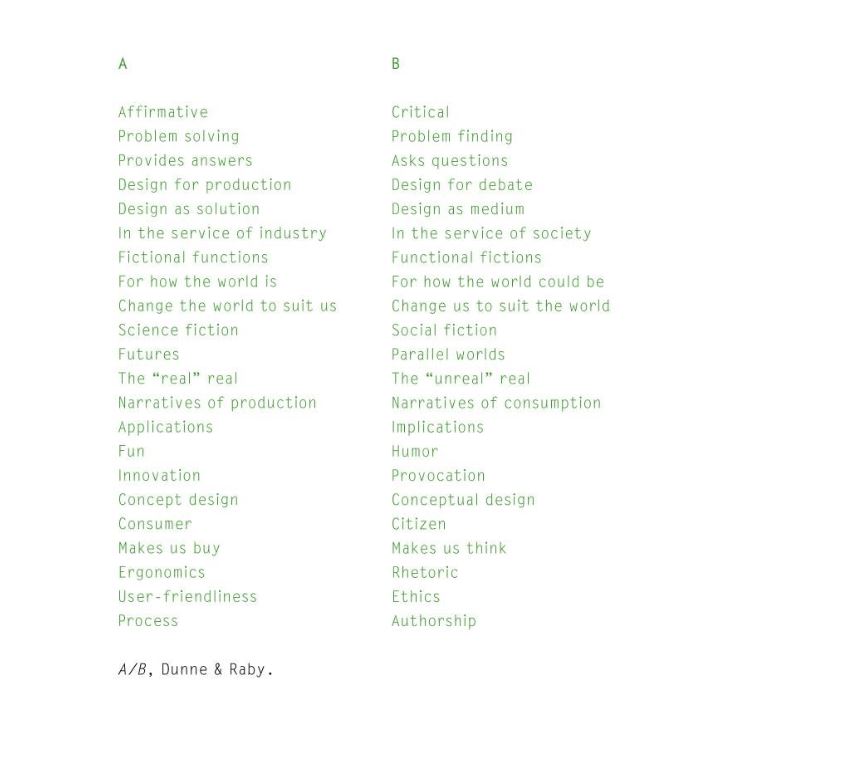
The ‘B’ approach, opens questions and aims at finding problems, approaching design as a critical and conceptual exercise. Having employed both ‘A’ and ‘B’ approaches, I feel that I often find a greater level of creative fulfillment in this ‘B’ approach, and hope to explore it further through this project (and possibly through an MA programme that allows such exploration).

 design factory