
11 November 2019
The project launch highlighted the independent nature of practice that was required from us during this stage, mirroring the approach required for the MA.
The investigate project would encompass a number of ideas and experiments based on our respective areas of interest and design problem identified, serving as a basis for the Realize project next month. This would be followed by a further curatorial exercise through ‘Launch’, the last project within the Grad Dip.
This project focuses on practical exploration as an important means of conducting research, while also helping us identify the ideas, approaches, techniques and materials we would like to take up during the next project. In a sense it is in itself, a new approach toward looking at a project.
The brief for my pathway asks us to consider the question of how design could improve people’s lives, with example problem areas (or paradigms?) including compact living, packaging, aging population, water, food security, waste, etc. By identifying gaps in the market, we are required to come up with innovative solutions to an individually identified problem.
While I am excited about the speculative and experimental nature of approach required for this project, I am currently feeling a bit disoriented with respect to my first step.
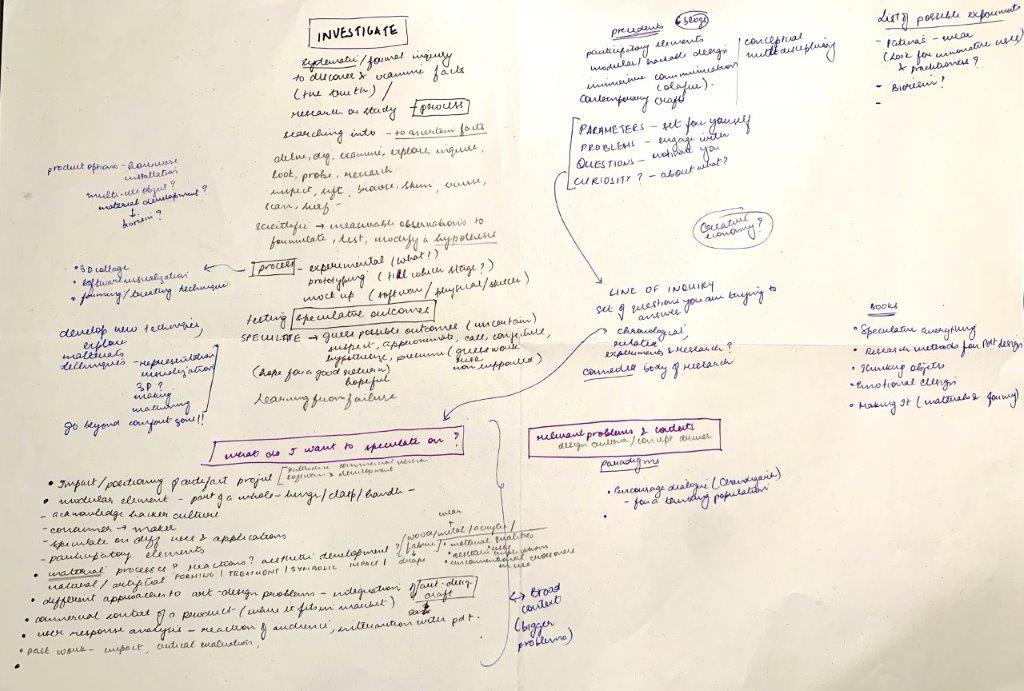
The following is an ongoing interpretation of the brief, and some ideas I wish to explore in this project.
The project launch was followed by a presentation on the processes and approached adopted by Isabel, Clare and Julian, in creating their respective works.
Isabel’s project was based on her travels to Isle of Wight, and inspired from the boulders as a backdrop for her intricate, laser cur architectural and interior elements such as ladders and miniature furniture.
Clare showed us her ‘Material Remains’ project, which questioned the presence and simultaneous absence of objects in their respective lino prints. Another project covered and later uncovered elements of inherited objects, from within thick black paint, giving her works a spirit-like appearance. She divided the trasformative process into 3 stages – embalming, burial and exhumation.
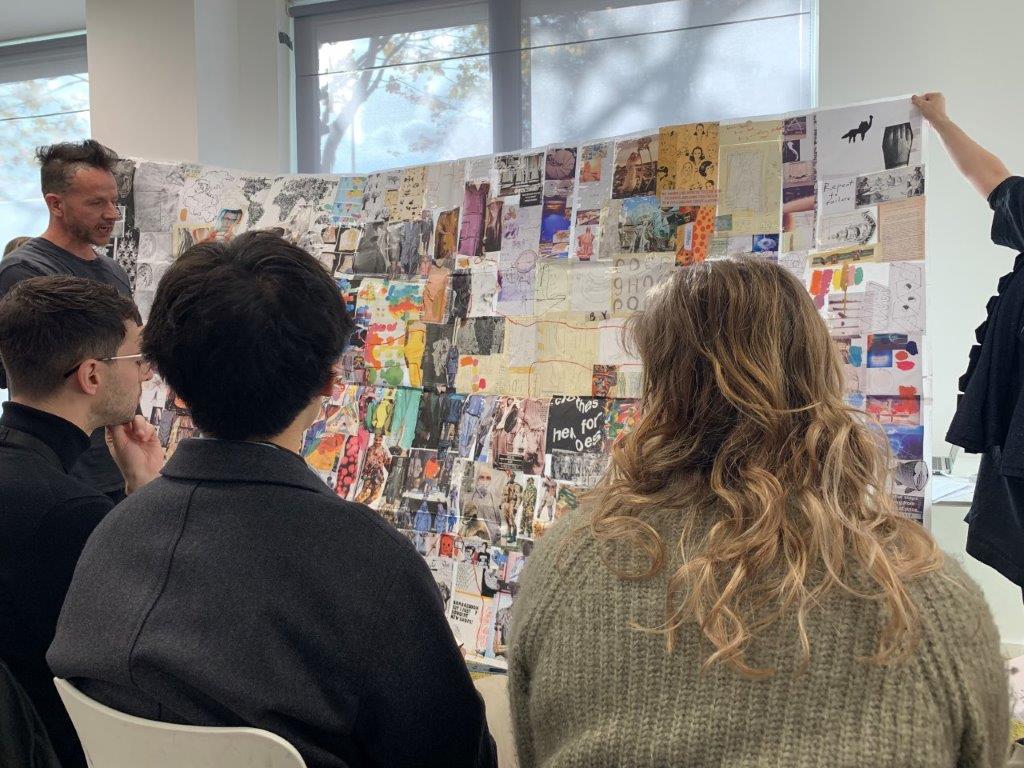
Julian explained that his was a nomadic studio, often housing a collection of works, before being dismantled to another place. For each collection, he created a kind of research cum moodboard holding clustered information, inspiration, experiments and resources, which he carried everywhere with him, to get the sense of a mobile studio. I could relate with this approach, since I often find the need to be close to all my materials and research wherever I could possibly be working. Moreover, this keeps all ongoing research and ideas in one visual dimension, preventing ideas to escape the mind, or an important article from getting lost. Moreover, his creation of custom shades for his fabric dyes, and painting with his hands, revealed a sense of passion and engagement with his craft.

 design factory