
13 November 2019
I had been meaning to view this exhibition for a while now, and felt that week one of the Investigate project might be a good time, hopefully to inspire and direct me, early on in the project. I left the TATE with an exciting new discovery: a contemporary practitioner engaging with art, science, geometry, sculpture, experiential design and architecture.
Olafur’s practice engages with immersive and experiential installations using elemental materials like water, fog, mist, light etc., to depict natural and scientific phenomena and principles like reflection, rainbows and optical illusion. A number of these works deal with raising awareness regarding climate change crisis, through a non-fear based approach towards these issues, while other works promote self-awareness and contemplation among viewers, making them co-collaborators in the artwork.
This is a space, totally dependent on you being there. When you leave the exhibition, there is nobody in the room. There’s also no art.
Abstract: The Art of design, Netflix Documentary
The model room was the first exhibit that I encountered in the exhibition, a large glass enclosure housing study models, geometric studies, experimental pieces and potential proposal models for Architectural structures, light fixtures, kaleidoscopes, mobiles and water features, executed in varying scales and materials.
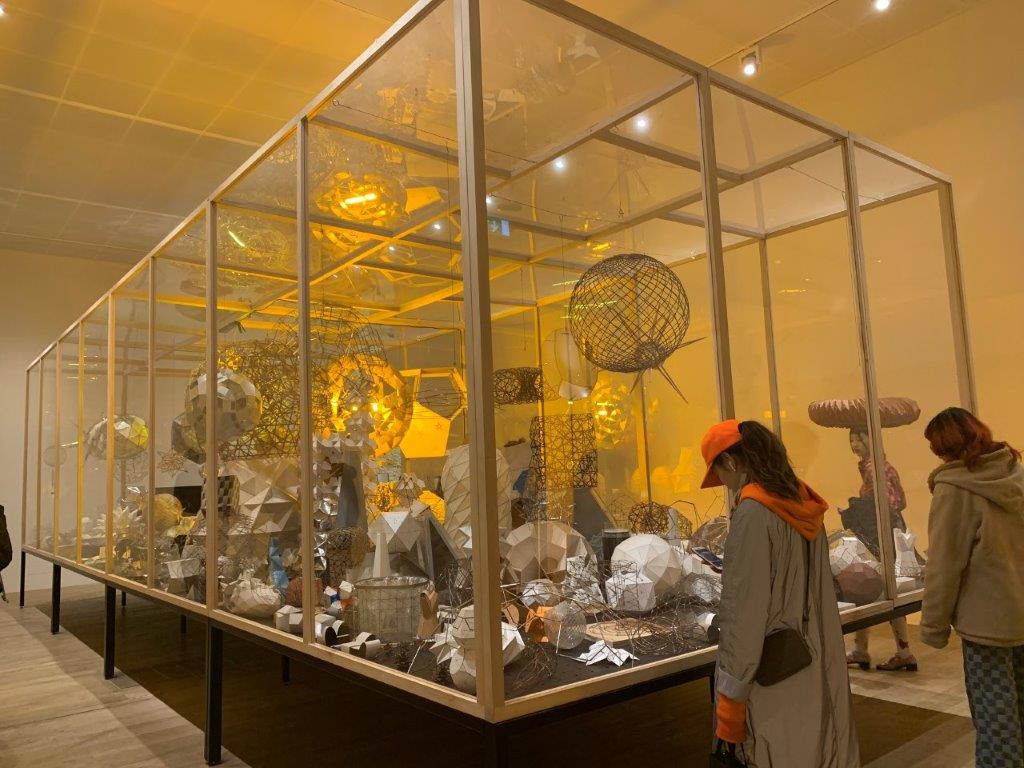
The Model Room revealed the hands-on process of creation within Olafur’s practice, and inspired me to approach making and development as a parallel research and execution process. I was also intrigued by the geometry studies within paper spheres and some light fixtures, which I later learnt, were inspired from Buckminister Fuller’s Dome, and were created in collaboration with Einar Thornstein, an Architect, and a friend of Buckminister Fuller. I could relate with the wireform architecture pieces, and looked at soldering as a possible option for my future encounters with wireforms (as opposed to wire wrapping which is time consuming and painful, or welding- which I currently don’t have access to). The paper models were interesting in that they revealed a progression and learning – as representation of geometric object graduated to glass and sheet metal after initial studies in the humble paper.
The next room exhibited some immersive and thought provoking installations such as a projected window, a rain window and a kinetic wave machine, apart from others. I was interested in the different techniques and materials used to convey emotions and make people think – lenses, motors, projectors, even living moss. Some works like ‘I grew up in silence and solitude’ – were as simple as a candle burning on a round mirror base. I feel that every viewer in the gallery might have interpreted pieces like this in their own, unique way. This, as I learnt through the Netflix documentary, ‘Abstract – The Art of Design’ featuring Olafur Eliasson’s practice – was essential to the theme and goals in Olafur’s practice.
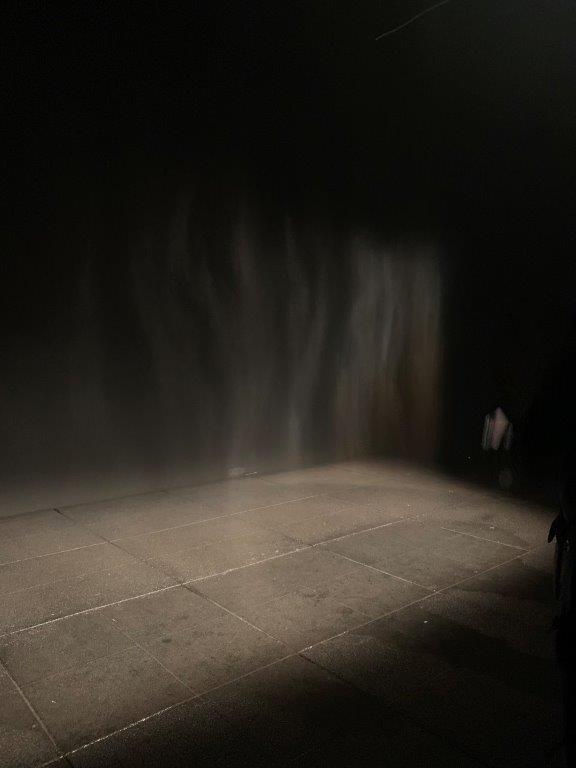
‘Beauty’ drew from the rainbow as a natural phenomena, allowing viewers to experience their own rainbow, since everyone’s viewing angle was different depending on height and location.
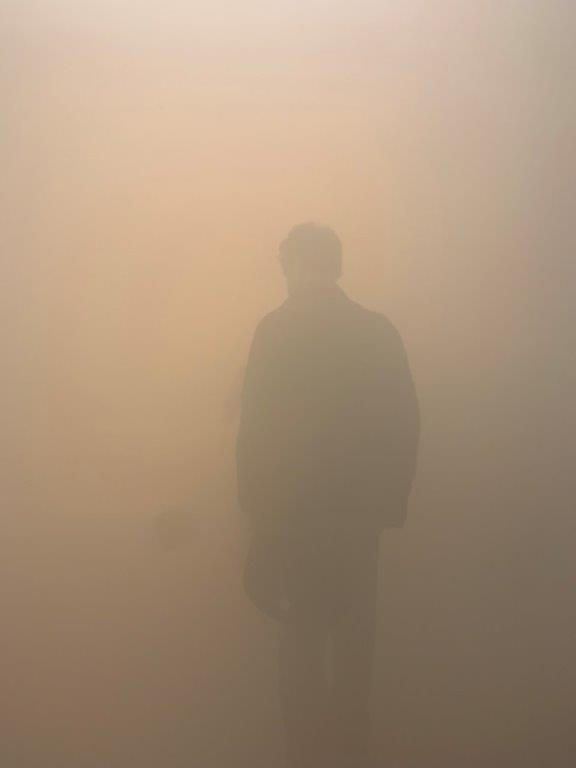
The blind passenger was probably the most dramatic of experiences within the exhibit, requiring viewers to move through a fog filled corridor, without being able to see much of where they were headed. I later learnt that the exhibit was an experiential means of educating people on the grim consequences of air pollution.
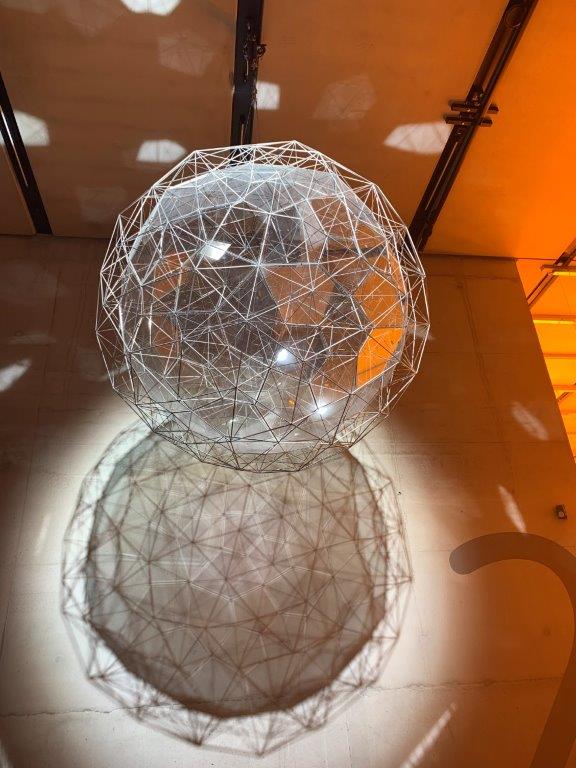
Cold Wind Sphere 2012 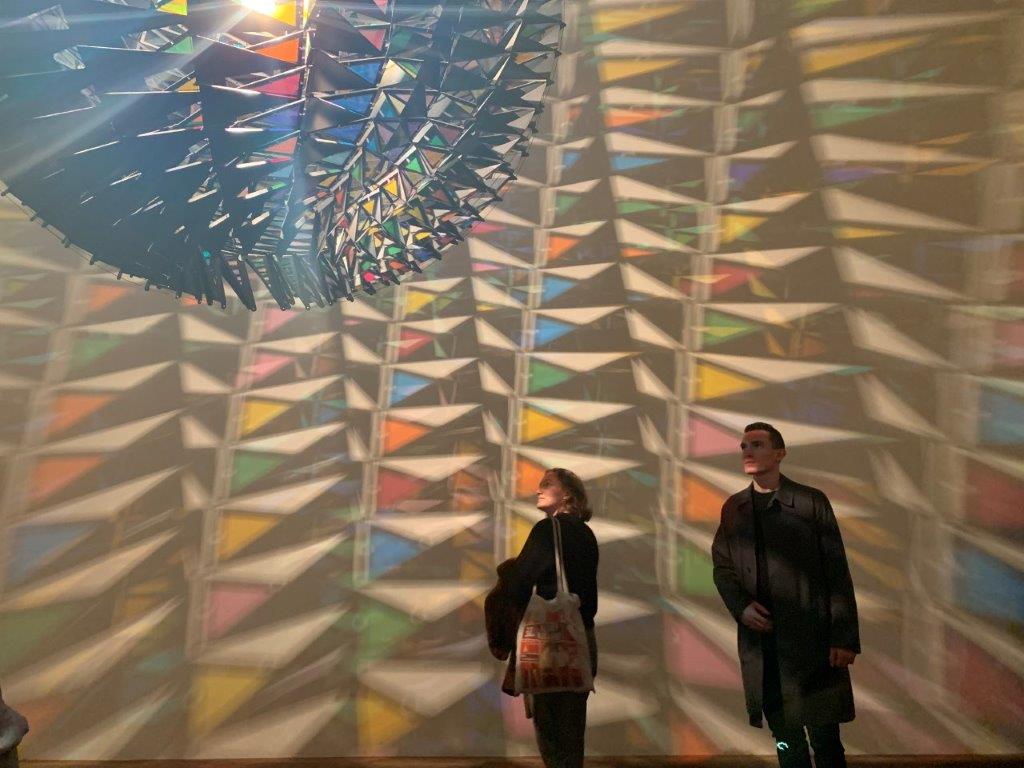
In Real life 2019
‘Cold Wind Sphere’ and ‘In real Life’ were two fascinating geometrical light fixtures, casting moving shadows across walls, as they swayed gently. Both works had intriguing joinery and geometry holding up pieces of clear and coloured glass within their their spherical forms.
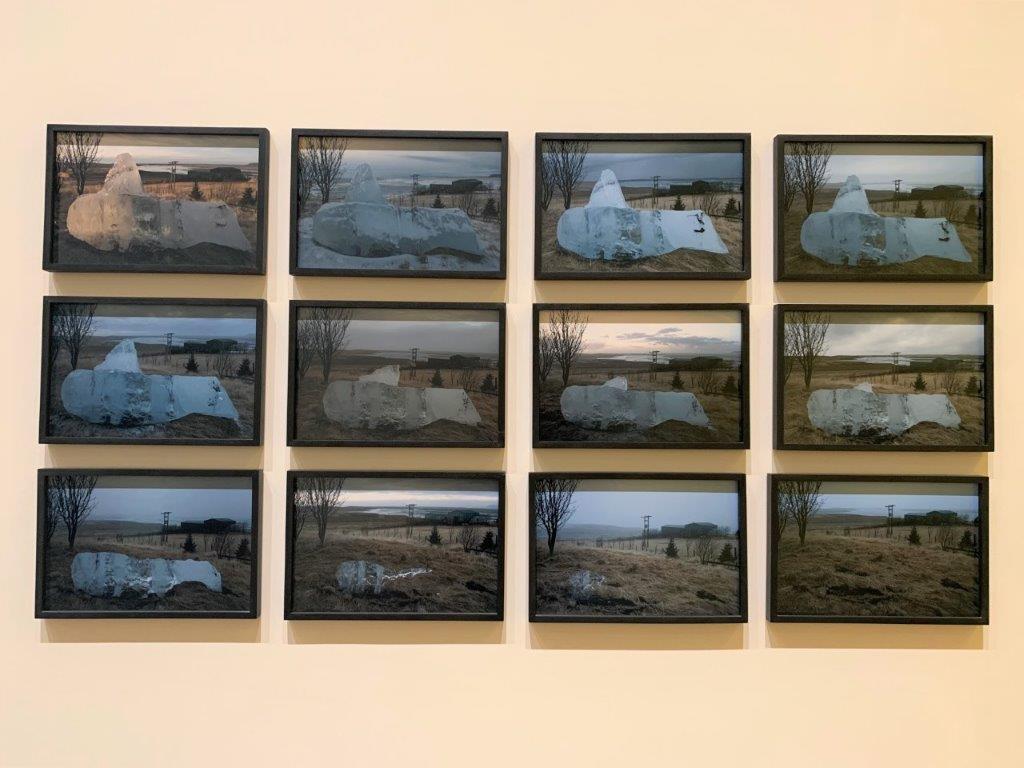
‘Melting Ice on Gunnar’s Land’ and ‘Ice Watch’ were emotionally arousing photographic and performance works respectively, that drew attention towards the issue of melting glacial ice in Iceland, where Olafur grew up as a child. Combining performance art within the issue of climate change, seemed like a genius idea to me, since it not only succeeded in capturing public attention toward an otherwise overlooked or ‘uninteresting-to-general-public-issue’, but also brought the real action of melting ice- up and close for experience, within squares of Paris, London and other cities.
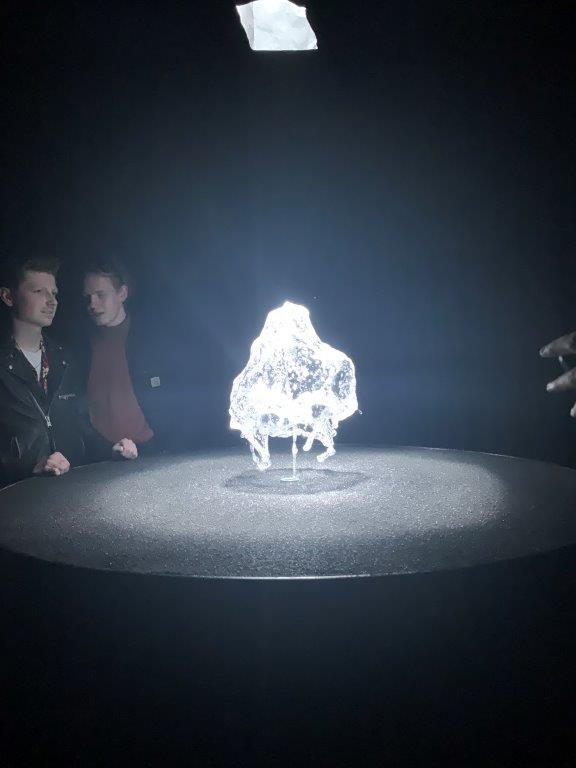
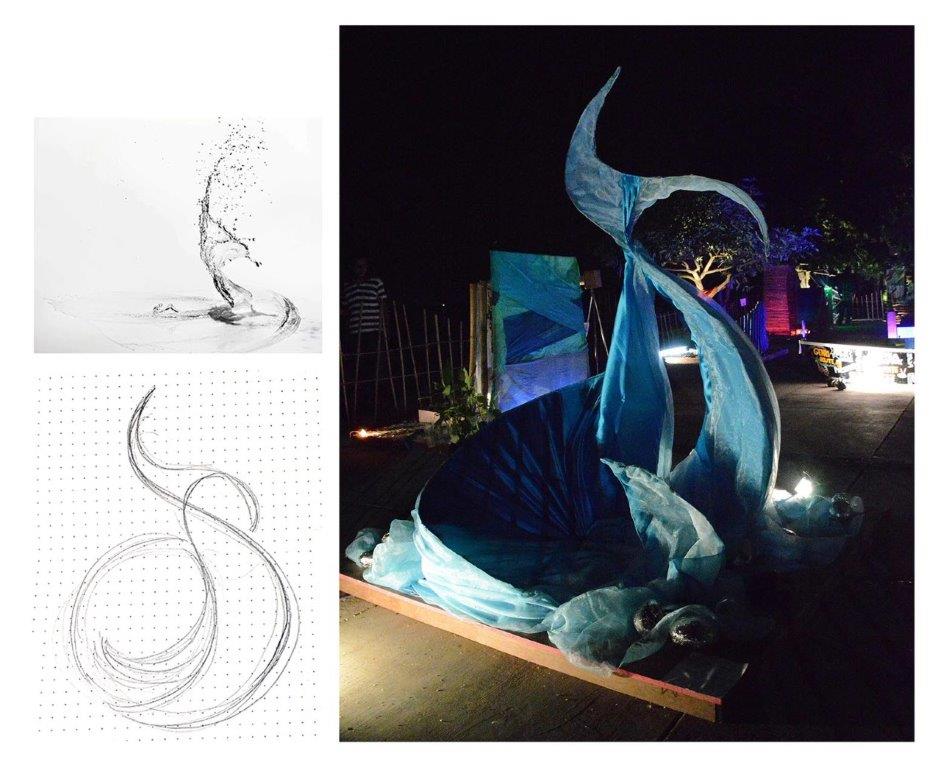
The ‘Big Bang Fountain’ froze the transient image of a water fountain, as it was lit by a spotlight for a split second at intervals in a darkened room. Finding it hard to time my photograph, I realized the value of this ‘moment’ of sensory experience. The exhibit was especially relatable to me as I was reminded of one of my previous projects from Architecture school, where I had tried to capture the stance of a splash through a fabric and wire-mesh installation, intrigued by the fluid shapes of water.
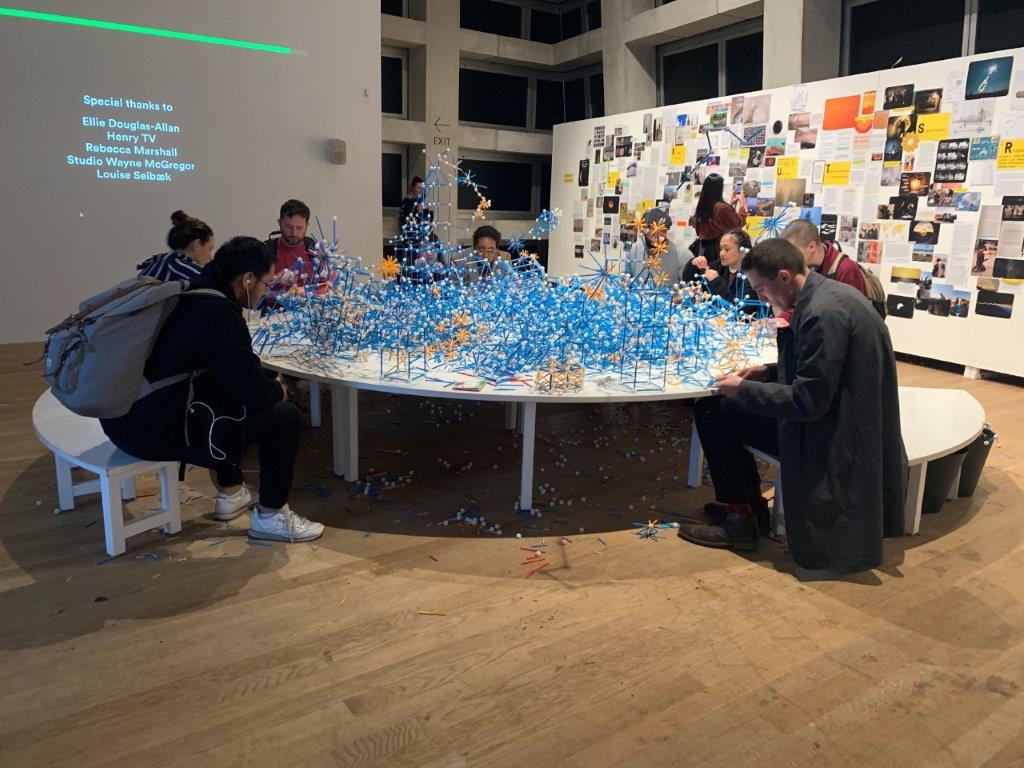
In the expanded studio section, the structural evolution project encouraged visitors to pick up modular building blocks, and create their own structures- which I felt was an empowering gesture from the artist.
Olafur’s approaches that I find relatable for my own practice and would potentially like to learn from:
- Interdisciplinarity – spatial design, physical objects, structures
- Experience oriented design – using the audience as part of the artwork, interest in public response toward design
- A sense of contemporary craft in the execution (welded wireforms, folded paper, partially handmade models)
- His interest and exploration of scientific and natural phenomena – and corresponding thoughtful incorporation in projects
What you see is quite upto you.
Abstract: The Art of design, Netflix Documentary
Inspiring elements of Olafur’s practice that I could consider adapting:
- Generating awareness on climate change (Ice watch project and other photographic works inspired by Iceland’s glacial ice)
- Green energy generation (Little Sun solar light)
- Use of technology to support early visualization and execution (parametric and geometric designs)
- Adopting a collaborative culture – in fields where he felt he had ‘little knowledge’ to be able to execute a problem – (Don’t let technical restrictions come in the way of imagination, adopt collaboration as an efficient and learning route to new and diverse design problems)

 design factory