
01 November 2019
M2: Art & Design Practice Feedback with Gary
- Look at ways to respond to materials – push harder – explore deeper – ways of using same materials in different ways – think out of the box
- Look at drawing in different way – metaphorical/symbolic techniques and materials – express unique qualities, be more playful with drawing
- Develop and evidence digital skills – see what cad and rhino can do to Artefact handbag – ivy looks more alive, maybe a stop frame of ivy growing and locking over cage in time
- Navigator – flapping wings of velcro on wheels – collect trash as it moves – think a step further, go beyond what already exists – initiate change, make a difference – breakdown whats happening around – respond deeper – through making – complex area
- Software (industry standard) as tools – develop next version of handbag (maybe with market context?) in 3d, prospects for manufacturing (in whatever numbers and range)
- Methods of independent research – book
- Artefact – missing research – look at handbags (in detail)
- Living shoes idea – not just ivy, maybe bio molecular growth in footwear – grow – remake – (here’s where contemporary research fits in)
- Reflect on my practice as Jeweller? (adornment) or designer (practice reflects a confrontation of aesthetic and functionality, evaluate importance of each, maybe focus on each/both systematically?) Look at active movements in different areas of products, jewellery, interdisciplinary design practices for references, direction.
- Look at Dutch design movement – Droog, Handbag Museum, Tord Boontje (participatory design) (make weekend trip to Amsterdam?)
- leave more time to fail – more speculative research – open ended ideas and practice – explore more than one idea at a time – keep developing side by side
M4: Portfolio review
- Annotation – less descriptive, more evaluative; Convey critical reflection and development through annotation (critical awareness of issues, impacts generated by my ideas, articulate intellectual and technical processes)
- More drawing – explore more methods of drawing (instead of conventional pencil paper – more symbolic materials – cool glass draw butterfly with finger? transience, fragility
- More software evidence – use as tools in research/development/evaluation/further research and ideation
- Update with development work from new projects as and when – make each project section more succinct, convey more with less
M1: ADAS Inputs
- Principles and methods of independent research: Breadth and depth (explained by Aleya as mentioned in diagram)
- Situate your ideas and goals in context to wide array of kinds of precedents (relating different aspects of research); critically analyse precedents – aims, provenance of individual processes, products, impact, relevance to current research and my ideas; specify from the wide range, specific precedents of interest and relevance; narrow down and study deeper – precedents and takeaways for my research and ideas. How it relates with contemporary art & design practice – contextualize studies in the body of essay/practice.
- Conclusion – broaden again – situate research with contemporary practices and context. Situate design work with contemporary context and precedents.
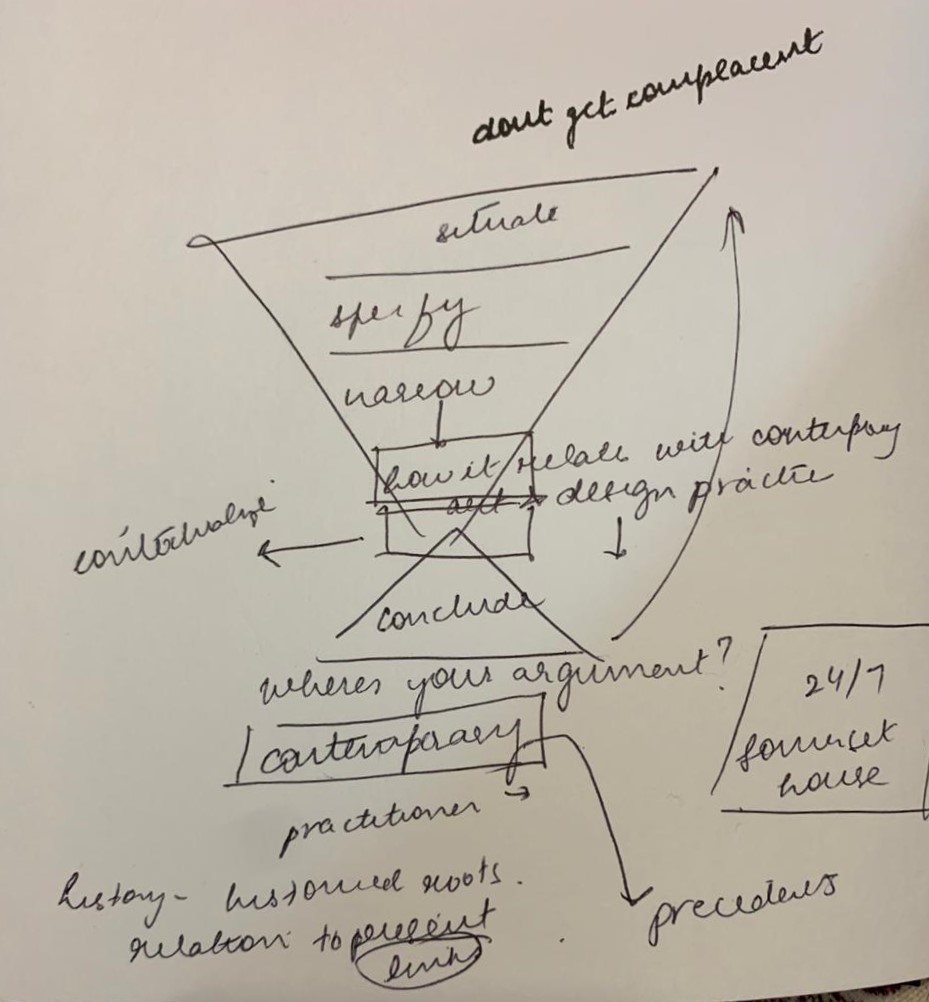
- Don’t get complacent, keep working and pushing harder
- Next project – longer essay – revisit after intervals – better editing. Appreciated integration of feedback in second revisions.
- Choosing and researching precedents – critical analytical study – not skimming through, contemporary for future directions, historical for roots, evolution of a problem/product/idea, learning from roots
- Artist Statement: add references – Comments – sketches – reference context of ideas, London’s Iconic telephone boxes, empowering art scene in Shoreditch, Making Simple Automata, influences – Frank Lloyd Wright, Charles Correa, Wendy Ramshaw – references to material, space, volume and modularity in their work, immersive interaction with London – museums, Kew Gardens, Exhibitions, encounters, Shoreditch, Repository of resources at RCA (thanks Anna and Annie!), novel uses for materials and technology – recent exploration
- Book – where’s your argument – create meaningful sentences –
- 24/7 Somerset house – exhibition for all pathways
Reflection:
- Overall – stage 1 and feedback has been a deeply Learning experience, allowing exploration and experimentation with uncharted design issues, materials and techniques
- In stage 2, I hope to explore my ideas as user-oriented products, while also engaging deeper with ideas, precedents and issues through speculative experimentation.
- Work on drawing as a tool, medium and development practice. explore various forms, mediums and techniques of drawing
- Develop knowledge of industry standard software – speculate contextual manufacturing and application of ideas, user response through software and other research (look at procreate, solidworks, rhino; develop sketchup, cad, adobe suite)
- explore more contemporary precedents, designers, artists and studios – align my vision to novel products and breakthrough design (also lookup trendhunter – installations)
- Engage with identified research topics and precedents at a deeper learning and critically evaluative level – analyse positives and negatives subjectively, assess my own interpretation and referenced evaluation of works studied.
- During Stage 1, I have identified trends and methods beneficial to my own practice, ideation and development. I hope to continue to explore these methods while also exploring new ones:
- Taking inspiration from ‘outside’ as opposed to internet based research has helped me be more imaginative and contextualize my ideas, taking inspiration from the vast (and sometimes unintentional) sources in the city of London and beyond. Travelling has helped me look at different contexts, landscapes and cultures.
- Studying artists and designers with works relevant to my design issues – has helped me form a basic understanding of the context of products, and current trends in the application of art and design.
- Realizing the importance of user experience, attempting to make an impact, analysing user and public response of my work and impacts generated by the works of selected artists and designers.
- Attempting open ended, speculative work, going beyond my comfort zone of ‘functional design’ and delving into areas that have previously been inaccessible
- Attempting to fuse my craft inclinations with design – develop intentions and practical application further
- Contextualize and develop current and previous projects with respect to market and consumer trends, experience, manufacturing processes and design development

 design factory